What to Expect on a Teide Stargazing Tour
How cold Mount Teide gets at night, what to wear, when the tour actually starts, whether there are toilets, and what the evening looks like hour by hour.
The two things that catch people out on a Teide stargazing tour are the temperature and the meeting time. You leave a resort at 24 °C in a T-shirt and end up standing still for two hours at 2,000 m in the dark; and the voucher says one time while the operator’s WhatsApp says another, because sunset moves by more than an hour across the year.
Neither is a problem once you know. Here is the evening, honestly, from pickup to drop-off.
Check Availability
How cold does it actually get?
Colder than almost anyone expects, and the gap between the coast and the caldera is the whole point.
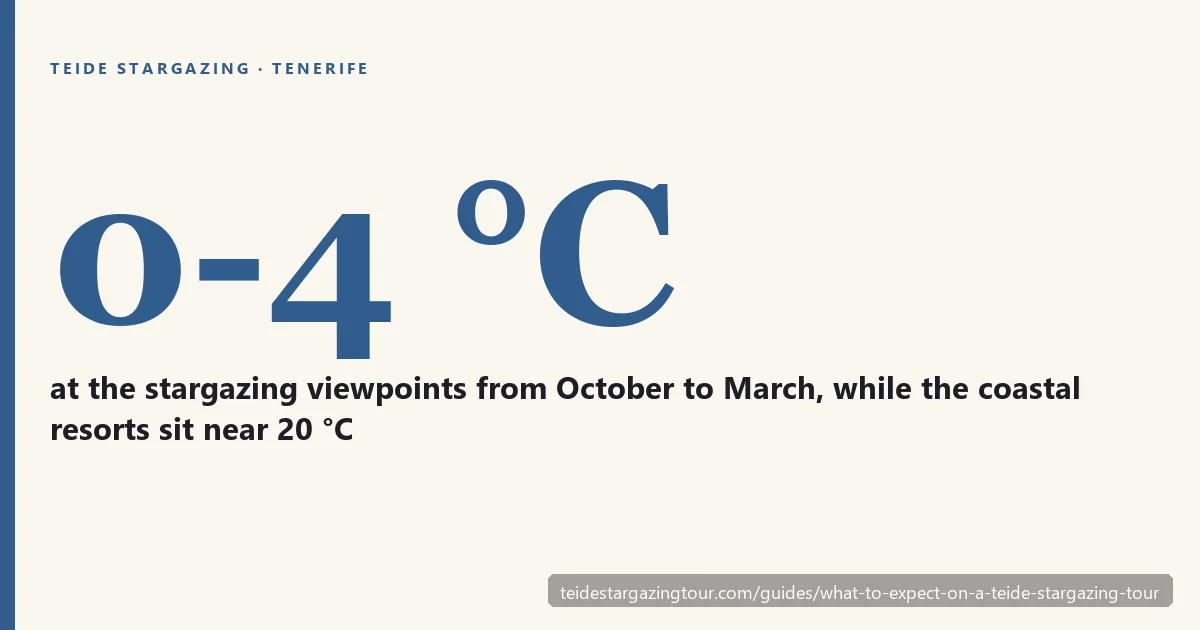
Operators publish their own figures. One states 0–4 °C from October to March and 10–15 °C from April to September at its meeting point. Add wind — the caldera is exposed and often breezy — and add the fact that you are standing still rather than walking. A January night at 2 °C with a 20 km/h wind, after ninety minutes of not moving, is genuinely cold.
Meanwhile the resort you left may still be at 18–20 °C. Every operator’s “warm clothing” line is the most-ignored sentence on the listing.
What to wear, minimum:
- A real jacket — insulated, wind-resistant. Not a hoodie.
- Long trousers. Not shorts.
- Closed shoes. Sandals and flip-flops are explicitly excluded by some operators.
- In winter: thermal base layers, hat, gloves. One operator lists thermals in its what-to-bring.
Who lends coats? Some tours do and most do not. The dinner and stargazing safari lends warm coats if required; the VIP option on our featured tour lends warm jackets. The most-booked tour explicitly lists jackets and blankets as not included. Check your option rather than assuming.
The meeting time is not the time on your voucher
This trips up more people than the cold. Because the sessions are keyed to sunset, the start moves through the year — an observing session that starts around 21:45 in July starts around 18:50 in December.
Most operators handle this by sending the exact time and place by WhatsApp on the afternoon of the tour, and several state outright that the time printed on the digital ticket is generic and should be disregarded. At least one treats being unreachable by WhatsApp or email as a no-show, with no refund.
So: keep your phone reachable and on data or wifi on the day, read the message when it lands, and do not plan anything tight around the voucher time. If you are landing in Tenerife that afternoon, book for a later night — one operator recommends exactly that.
The shape of the evening
Pickup or meet-up. Pickup options collect from the south-coast resorts, typically between El Médano and Los Gigantes; self-drive options meet at a confirmed point in the park. Self-drive means a rental car — operators are explicit that a taxi or public transport will not be accepted, partly because you may need to follow the guides if the group relocates.
The climb. Forty-five minutes to an hour and a half from the coast, through banana terraces, then pine forest, then out above the cloud deck. The moment you break through the mar de nubes is the first genuine wow of the night, and it happens in daylight.
Sunset. Sunset-and-stars tours stop on the western side to watch the sun drop behind La Gomera, La Palma and El Hierro. Cava or a soft drink is handed round on most of them.
The dead forty minutes. After sunset there is a lull while the brightest twilight fades (full darkness takes roughly 75 to 95 minutes). Guides use it to set up and to let your eyes adapt. Pure observing sessions simply start here instead, which is why they are shorter and cheaper.
The sky tour. A green laser picks out constellations; the guide gives you the mythology and the physics. This is the part that makes the difference between a dark sky and an understood dark sky.
The telescope. You queue for the eyepiece. What is in it depends on the moon and the season — see the best-time guide.
The photo. Nearly every operator finishes with a long-exposure portrait of you under the stars, sent afterwards at no extra charge. It is a genuinely good souvenir and it is included more often than not.
Practical answers nobody puts in the listing
Toilets. Generally none. Several operators list this explicitly among exclusions — no facilities at or near the viewpoints, and none on the bus. Sort it out before you leave the coast.
Food. Only the dinner tours include any. On the others, eat first — there is nothing open up there.
Altitude. The observing sites sit at 1,400–2,300 m, which is high enough that operators warn people with conditions affected by altitude, and one advises against it for children under about seven to nine. Most visitors feel nothing beyond the cold.
Red light. Guides use red torches to preserve dark adaptation. Keep your phone screen dimmed and off — a white screen resets everyone’s night vision, including yours.
Getting back. Expect to be back at your accommodation between 23:00 and 01:00 depending on the option. The nine-hour tour is a full evening.
Frequently asked questions
How cold is Mount Teide at night?
Operators quote roughly 0–4 °C from October to March and 10–15 °C from April to September at the stargazing viewpoints, before wind chill — while the coastal resorts may be fifteen degrees warmer. Dress for a different island.
What should I wear on a Teide stargazing tour?
An insulated, wind-resistant jacket, long trousers and closed shoes as a minimum, plus thermal layers, hat and gloves in winter. Some tours lend warm coats but most do not, so check your specific option.
Are there toilets on a Teide stargazing tour?
Usually not. Several operators list the absence of toilet facilities at or near the observing sites among their exclusions, and there are none on the bus. Use them before you leave the coast.
What time does a Teide stargazing tour start?
It follows sunset, so it shifts by more than an hour across the year. Most operators confirm the exact time by WhatsApp on the afternoon of the tour, and several say the time printed on your voucher is generic and should be ignored.
Is Teide stargazing suitable for children?
Often, but check the option. One operator does not accept children under five on its pickup option, another warns that high-mountain conditions may not suit children under about seven to nine, and the observatory visit requires ID to prove a child’s age. The cold and the late finish matter more than the astronomy.
Do I need my own car?
For the cheaper self-drive options, yes — a rental car specifically, not a taxi. Tours with pickup cover the south-coast resorts, and one collects from Puerto de la Cruz on selected days. See the self-drive comparison.
Ready to book? See the featured Teide stargazing tour →
Related reading:
See the Milky Way Rise Over the Caldera
Sunset above the sea of clouds, then constellations, planets and deep-sky objects through a real telescope with a Starlight-certified guide. Free cancellation up to 24 hours before.
Check Availability & Book