Stargazing in Tenerife: The Complete Guide to Mount Teide
Everything you need to plan a night under the stars at Mount Teide — why it works, what you can actually see, the best time of year, and whether to go it alone or book a tour.
Mount Teide is the obvious first choice for stargazing in Tenerife, and it earns that reputation honestly. High altitude, low light pollution and a broad volcanic plateau combine to create one of the best night-sky environments in Europe — good enough on its own merits, and good enough that you can experience it either independently or on a guided telescope tour.
This is the overview: why the park works, what you’ll actually see, when to go, and how to decide between doing it yourself and booking a guide. Every section below links to a deeper guide if you want the full detail on that one question.
Check Availability
Why Teide Is So Good
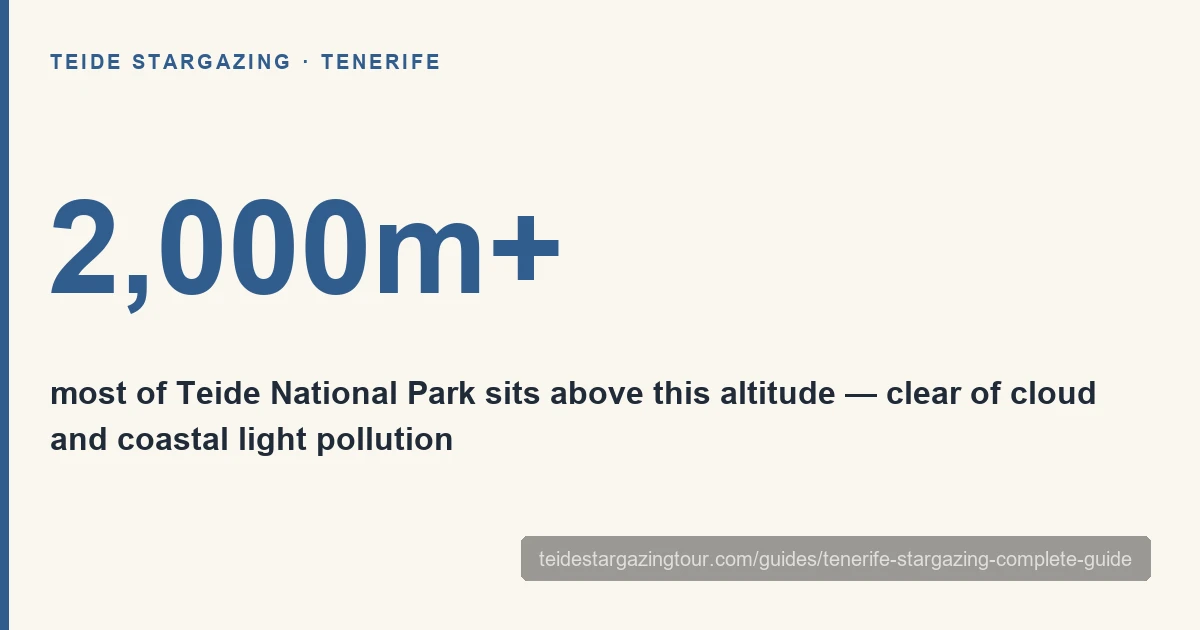
Much of Teide National Park sits above 2,000 metres — above a large amount of the atmosphere’s moisture, and far from Tenerife’s main coastal light sources. On many nights the island’s persistent low cloud deck sits beneath the plateau entirely, which does double duty: it clears the air you’re looking through and shields the coastal light pollution at the same time. You don’t need the cable car, a summit permit, or an Observatory ticket to benefit from any of this — public viewpoints inside the park are enough, and it’s the reason Teide National Park has been a certified Starlight destination since 2014.
What You Can See
With the naked eye you can pick out major constellations, bright planets, the Milky Way when season and moonlight cooperate, meteors, and thousands of stars invisible from any resort. Binoculars add star clusters and rich fields of the Milky Way that the naked eye smooths over. A telescope is the right tool for the Moon, the planets, and individual deep-sky objects — galaxies, nebulae, star clusters — that need aperture to resolve any real detail.
Best Time of Year
Summer is the strongest season for the classic Galactic Core and Milky Way photography, when the bright, structured heart of the galaxy rides high in the evening sky. Winter trades that for Orion, Taurus and the Pleiades, plus genuinely early darkness. Spring and autumn are excellent transition seasons — May and September in particular are useful for travellers trying to balance sky quality against practical timing and temperature. Moon phase matters more than any of this: book close to new moon and the difference is dramatic. The full breakdown, month by month, is in our best-time guide.
DIY or Tour?
DIY is best if you value flexibility, want to shoot photography on your own schedule, or plan a long meteor-watching session that doesn’t fit a tour’s timetable. A rental car and a public viewpoint are genuinely all you need.
Guided tours earn their price with a telescope you couldn’t easily bring yourself, someone who knows what’s actually up tonight, and — for most options — transport, which matters if you’d rather not drive mountain roads after dark. If you’re weighing the two seriously, our self-drive versus guided tour guide covers the trade-off in full, including the best free viewpoints.
What to Bring
Take long trousers, closed shoes, a fleece or jumper, a proper jacket, water, a charged phone and a dim red light to protect your night vision. Photographers should add a tripod and a spare battery — cold drains them fast at altitude. Give your eyes twenty to thirty minutes away from bright screens before you expect them to adapt fully to the dark. Check the high-altitude forecast before you go, not the resort one — the coast and the caldera run very different weather. Full detail on temperatures and what tours typically provide is in what to expect on a Teide stargazing tour.
Final Verdict
For a first Tenerife night-sky experience, Teide is hard to beat. Self-drive if you value flexibility above everything else; book a guided sunset-and-stargazing tour if transport and a real telescope matter to you, or the small-group observing session if you already have a car and just want the sky explained well. Above all, choose your date for the Moon and the weather rather than assuming the most expensive tour automatically buys the best sky — see which Teide stargazing tour is right for you for the full comparison.
Frequently Asked Questions
Is Teide stargazing free?
General independent stargazing from suitable public areas can be free — you just need to get yourself there. Tours, Cable Car activities and Observatory visits are separate paid products layered on top of that free base experience.
Can you see the Milky Way?
Yes, especially in the warmer half of the year around low-moonlight nights. The galactic band is a naked-eye object from the park on a clear, dark night; moonlight is what washes it out, not cloud.
Do you need a telescope?
No. The Milky Way and the constellations are primarily naked-eye targets. A telescope adds the Moon, planets and deep-sky objects, but it isn’t required for the headline experience.
Can children go?
Yes, for DIY observing. Many commercial astronomy products set a minimum age, commonly around eight, so check the specific tour before booking if you’re travelling with younger children.
Ready to pick a night? See the featured Teide stargazing tour →
Related reading:
See the Milky Way Rise Over the Caldera
Sunset above the sea of clouds, then constellations, planets and deep-sky objects through a real telescope with a Starlight-certified guide. Free cancellation up to 24 hours before.
Check Availability & Book