The Best Time for Teide Stargazing: Month by Month, Moon Phase and Weather
Stargazing at Teide works all year. Here is what each month shows, when it gets dark, why the moon phase matters as much as the month, and how weather affects your night.
Stargazing tours run in Teide National Park all year, and every month has something worth seeing. Summer is the strongest season for the bright core of the Milky Way, winter for Orion and early darkness, and May and September are good compromises in between. If you can choose freely, a week around new moon in September gives the best overall balance: the Milky Way’s core is still up in the evening, darkness arrives at a reasonable hour, and the nights are not yet cold.
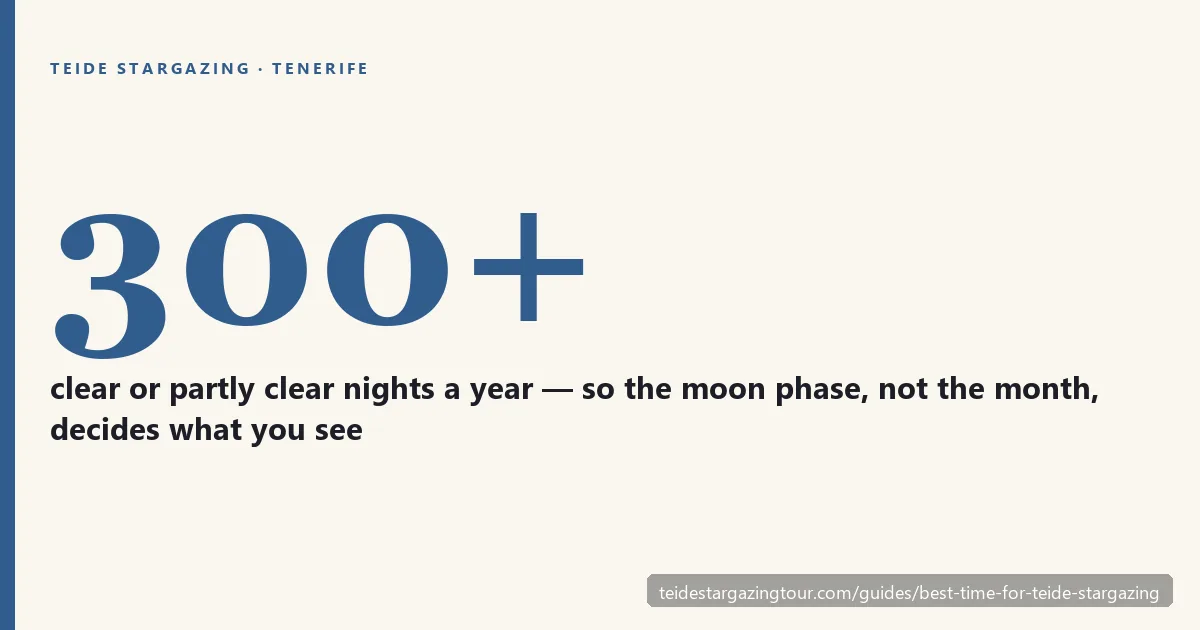
Moon timing can matter more than the choice between two neighbouring months. A new-moon week shows the Milky Way as a naked-eye band; a full-moon week trades it for a bright Moon in the telescope. Same tour, same guide, very different night.
Check Availability
Key takeaways
- The moon phase can matter more than the choice between neighbouring months. Check a lunar calendar before you check tour availability.
- June to August is the easiest classic Milky Way season, with the core up in the evening.
- December to February has a bright winter sky (Orion, Taurus, Sirius, the Pleiades) and darkness by about 19:30, but it is near freezing at the observing sites.
- September combines the end of the Milky Way season with earlier darkness than midsummer.
- Weather on the night matters more than any monthly average, so book a night early in your trip.
Month by month at a glance
Times are approximate local times for the middle of each month, calculated for the caldera. “Full darkness” is the end of astronomical twilight, when the faintest objects appear; tours start earlier than this. The Milky Way column is when its bright core in Sagittarius is at least 15° above the horizon in a dark sky.
| Month | Sunset | Full darkness | Milky Way core | What stands out |
|---|---|---|---|---|
| January | 18:30 | 19:55 | Not visible | Orion, Taurus, Gemini, Sirius, the Pleiades |
| February | 18:55 | 20:15 | Just before dawn | The winter sky at its best in the evening |
| March | 19:15 | 20:35 | Last hours before dawn | Winter constellations setting, spring galaxies rising |
| April | 20:30 | 21:55 | From about 03:00 | Spring galaxies; the Lyrid meteor shower in late April |
| May | 20:50 | 22:20 | From about 01:00 | Galaxies early, Milky Way late at night |
| June | 21:05 | 22:40 | From about 23:00 | The core rises in the evening; latest darkness of the year |
| July | 21:05 | 22:35 | From darkness to about 03:30 | Classic peak-summer Milky Way |
| August | 20:45 | 22:10 | From darkness to about 01:30 | Milky Way plus the Perseid meteor shower |
| September | 20:10 | 21:30 | From darkness to about 23:30 | Milky Way in the evening, earlier darkness |
| October | 19:35 | 20:55 | Briefly, low in the west at nightfall | Andromeda, Pegasus, Cassiopeia |
| November | 18:15 | 19:35 | Not visible | The Pleiades and winter constellations return |
| December | 18:10 | 19:35 | Not visible | Geminid meteor shower; the earliest darkness of the year |
January to March
January and February are excellent for Orion, Taurus, Gemini, Sirius and the Pleiades, and the Orion Nebula is a headline telescope object. The nights are long and it is fully dark soon after 19:30 in January, which suits families and anyone who does not want a late finish. The cost is the cold: operators quote roughly 0–4 °C at the observing sites from October to March, before wind chill.
March begins the shift toward spring. The winter constellations are still up in the early evening, but it is not a convenient month for the classic summer Milky Way, whose core only clears the horizon in the last hours before dawn.
April and May
April is a transition month. The spring constellations take over, galaxies in Virgo and Coma Berenices are well placed for the large-aperture telescopes, and the Lyrid meteor shower peaks in late April. The Milky Way’s core is still an early-morning object.
May is increasingly strong for the Milky Way later at night, with the core up from about 01:00, and it is one of the best shoulder-season choices for photographers willing to stay out late. Spring is also when the difference between a small and a very large telescope is most obvious, because galaxies are faint and diffuse; the 32-inch large-telescope tour earns its price on a dark spring night.
June to August
The galactic core in Sagittarius and Scorpius, and the Summer Triangle overhead, dominate the sky. Which planets are up in the evening shifts from year to year: in the 2026–27 season Saturn is well placed on autumn and early-winter evenings, and Jupiter from about February to June 2027.
June has the latest darkness of the year, not until about 22:40, so the core rises into a dark sky only late in the evening. July is classic peak-summer stargazing, with the core up from the moment it gets dark. August adds the Perseid meteor shower, which peaks around 12 to 13 August. Nights are mild for the altitude (operators quote 10–15 °C from April to September), but bring layers anyway.
September and October
September keeps strong Milky Way views for the first couple of hours of darkness, and darkness arrives at about 21:30, more than an hour earlier than in late June. That is why it is the easiest all-round month for most visitors.
October shifts toward Andromeda, Pegasus and Cassiopeia. The Milky Way’s core is now low in the west at nightfall and sets soon after, so October is better for the autumn sky than for the core. Darkness comes earlier still, and the nights start to get cold.
November and December
The Pleiades and the winter constellations return, and Orion is up by mid-evening. December adds the Geminid meteor shower (peaking around 13 to 14 December) and some of the earliest darkness of the year, fully dark by about 19:35. It also brings the coldest mountain conditions of the year, so dress for near freezing.
Moon phase: the one thing to check first
Work out your dates, then check a lunar calendar, then check tour availability, in that order. Our full moon vs new moon guide explains why moonrise and moonset matter as much as the phase.
Around new moon (the darkest week) the sky is at its best. The Milky Way runs overhead with visible dust lanes in summer, and you need nothing but twenty minutes of dark adaptation to see it. Telescopes go after galaxies, nebulae and star clusters, which are exactly the objects moonlight hides first.
Around first and last quarter you get a compromise that many people prefer: the Moon is spectacular through a telescope along the terminator, where low sunlight throws crater shadows into relief, and it sets or rises partway through the night, leaving some dark time.
Around full moon the faint deep-sky objects are gone, and the Moon washes out the sky much as a streetlight does. What you get instead is the Moon at its brightest (impressive, but flat, because there are no shadows at full phase) plus the planets and the brightest clusters. If those are your only dates, book anyway and set expectations accordingly; it is still a remarkable sky.
One operator’s own listing puts it plainly: the Moon is only visible on certain nights and does not negatively affect the experience, while planets, galaxies and the Milky Way are visible only during certain times of year. Both halves of that sentence are true, and the second half is the one people miss.
Weather: cloud below you, wind above you
The thing that makes Tenerife’s sky work is the inversion layer. The island’s persistent cloud deck, the mar de nubes, sits below roughly 1,200 m, and so does the coastal light pollution. The observing sites are at 1,400–2,300 m, above both. A grey afternoon in Puerto de la Cruz very often means a clear night in the caldera, which is why you should not cancel because of the weather where you are staying.
Three things do close a night:
- Wind. Large telescopes act like sails, and one operator picks its observing site each evening based on wind direction and sends GPS coordinates on the day. Strong wind can cancel outright.
- Cloud reaching altitude. Uncommon, but real, especially in winter storms.
- Calima. A Saharan dust haze that sometimes blows over the Canaries, cutting transparency even when the sky looks clear. You cannot plan around it, but it explains the odd disappointing night in an otherwise good month.
Operators watch the forecast and contact you to reschedule or refund; to read it yourself, see our Teide stargazing weather guide. Almost every tour here also cancels free up to 24 hours ahead. The practical consequence: book a night in the first half of your trip, so a weather call still leaves you time to try again.
What time does the tour start?
Later than you think in summer, earlier than you think in winter, because the start time follows sunset, not the clock.
Pure observing sessions typically begin about forty minutes after sunset, once the brightest stars and planets are out. Full darkness, when the faintest objects appear, follows roughly 75 to 95 minutes after sunset depending on the date. That puts a Teide session start at around 21:45 in July and around 18:50 in December, and it is why most operators confirm the exact meeting time by WhatsApp on the day of the tour instead of printing it on the voucher.
Sunset-and-stargazing combinations start earlier still, because they need you at the western viewpoint before the sun goes down.
So when should you book?
If you can choose when to go: a clear week either side of new moon in September. The Milky Way’s core is still up for the first part of the night, darkness arrives at about 21:30, and you will not need winter layers. Choose June to August instead if the Milky Way is your priority and you do not mind a late night, August if you want the Perseids too, and December to February for Orion, early darkness and long nights, if you dress for the cold.
If your dates are fixed: book anyway, and match the tour to the sky you will get. A new-moon week is when the small-group observing session and the large-telescope tour are at their best. A full-moon week suits the Moonlight Tour, which focuses on the lunar surface through telescopes.
Frequently asked questions
What is the best month for stargazing in Tenerife?
There is no universally best month; the park records more than 300 clear or partly clear nights a year. September gives the best practical balance for most visitors: the Milky Way’s core is still up in the evening, darkness arrives at about 21:30, and it is not yet cold. August is the pick if you want the Milky Way plus the Perseid meteor shower.
What is the best month to see Orion from Tenerife?
January is excellent. Orion is high in the evening sky from December to February, with the Orion Nebula as a showpiece telescope object.
What is the best month for stargazing with children?
September or the winter months are often easier, because full darkness arrives earlier: about 21:30 in mid-September and about 19:30 to 20:00 from November to January, against nearly 22:40 in June. In winter, dress children for near-freezing temperatures.
Can you stargaze at Teide all year?
Yes, weather permitting. Tours run every month, and each season has its own highlights: the summer Milky Way, the spring galaxies, the autumn sky around Andromeda and the bright winter constellations.
Does the moon ruin stargazing at Teide?
It hides the Milky Way and the faint deep-sky objects, but it does not ruin the night. Around full moon guides switch to the Moon itself, the planets and bright clusters. If seeing the Milky Way matters to you, book within a few nights of new moon and check when the Moon rises and sets.
Can I see the Milky Way from Teide?
Yes, with the naked eye, on a clear night away from full moon. Teide National Park has been a certified Starlight destination since 2014 and sits above the island’s light pollution, so no telescope is needed for the galactic band itself. The bright core is an evening object from about June to September.
What is the calima and will it affect my tour?
Calima is a Saharan dust haze that sometimes drifts over the Canary Islands. It reduces the transparency of the sky even when there is no cloud. It is unpredictable and usually short-lived, and it is one reason operators reserve the right to reschedule.
What time do Teide stargazing tours start?
Pure observing sessions usually begin about forty minutes after sunset, so the start time shifts by about three hours between June and December. Most operators confirm the exact time by WhatsApp on the day; the time on your voucher is generic.
Final verdict
There is no universally best month. Choose summer for the Milky Way’s core, winter for Orion and early darkness, May for late-night Milky Way photography, and September for the easiest all-round mix of a good sky and a reasonable evening start. Whatever month you come, the moon phase and the weather on the night will shape what you see, so check both for your dates.
Ready to pick a night? See the featured Teide stargazing tour →
Related reading:
See the Milky Way Rise Over the Caldera
Sunset above the sea of clouds, then constellations, planets and deep-sky objects through a real telescope with a Starlight-certified guide. Free cancellation up to 24 hours before.
Check Availability & Book